Walking Through History: The Powerful Experience of Cape Coast and Elmina Castles
July 27, 2026 · 4 min read
There are some places you visit because they're beautiful.
There are others you visit because they're important.
Cape Coast Castle and Elmina Castle are places that ask something different of you. They don't ask you to admire the architecture or take the perfect photograph. They ask you to remember.
For many people, these two castles become the most unforgettable part of their journey through Ghana.
Not because they're the oldest buildings you'll see.
Because they tell one of history's most painful stories where it actually happened.
More Than Old Stone Walls
At first glance, the castles almost seem peaceful.
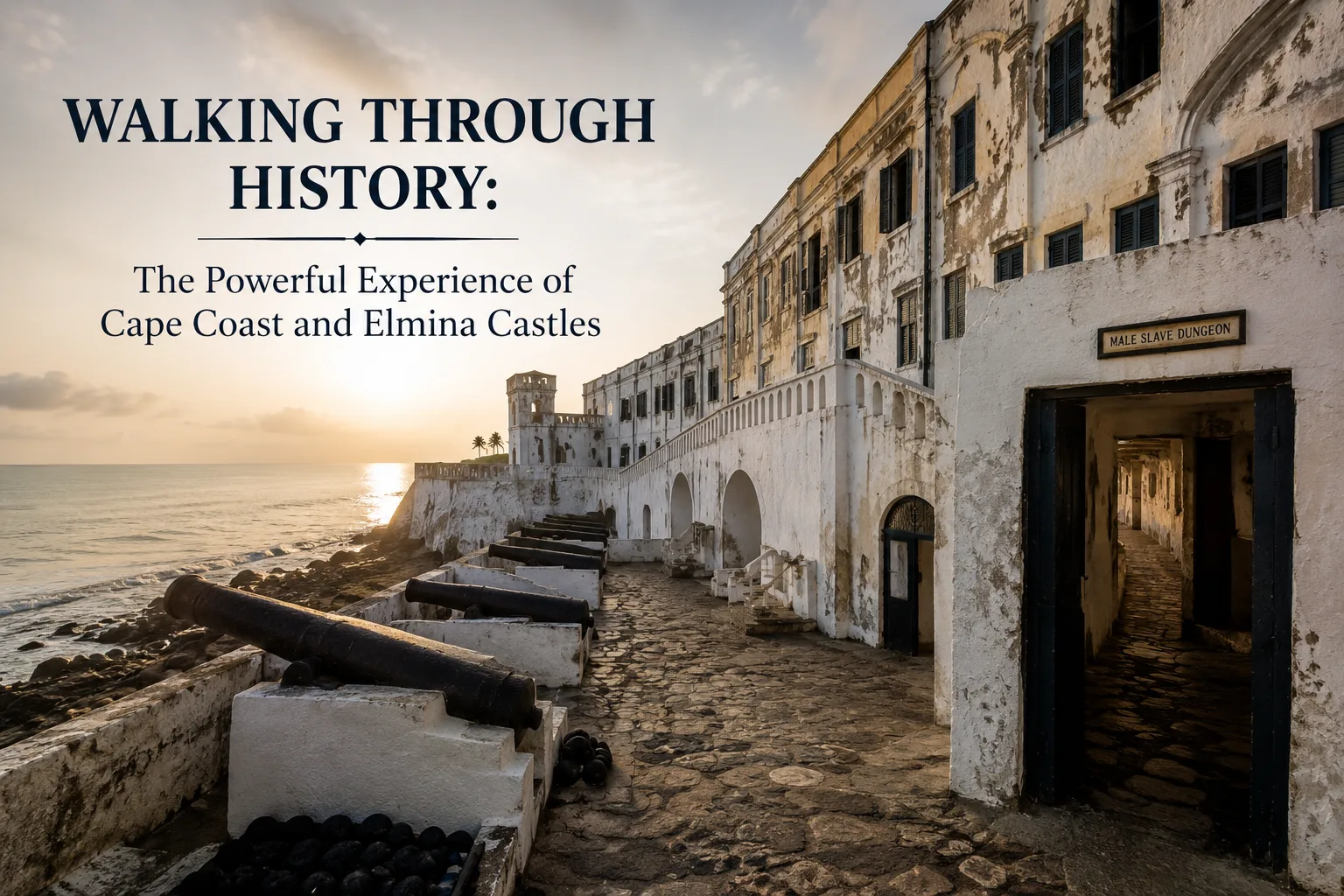
Whitewashed walls overlook the Atlantic Ocean. Waves roll gently onto the shoreline. Fishing boats drift across the water just as they have for generations.
It's difficult to imagine that these same walls once held thousands of men, women, and children who had been captured, imprisoned, and stripped of their freedom.
Cape Coast Castle and Elmina Castle became major centers in the transatlantic slave trade. Over hundreds of years, countless Africans passed through these forts before being forced onto ships bound for the Americas and the Caribbean.
History often feels distant.
Standing here, it doesn't.
The Dungeons
Every guided tour eventually leads visitors underground.
The temperature changes.
The light disappears.
The air grows still.
Inside the stone dungeons, it's impossible not to think about the people who were confined there under unimaginable conditions. Tour guides explain how hundreds of captives were held in crowded spaces with little food, little sanitation, and no certainty about what would happen next.
Nobody rushes through these rooms.
Most visitors slow down without even realizing it.
Some wipe away tears.
Others simply stand in silence.
The Door of No Return
Perhaps no place inside either castle carries more emotional weight than the doorway leading toward the sea.
Today it's known around the world as the “Door of No Return.”
For those forced through it centuries ago, it marked the final moment they would ever stand on African soil.
Families were separated.
Communities were broken apart.
Lives changed forever.
Walking through that doorway today is symbolic. Visitors know they can turn around and walk back. Those who passed through it generations ago never had that choice.
It's a powerful reminder that history is not measured only by dates and events, but by human lives.
A Different Perspective
People often arrive expecting to learn history.
Many leave having reflected on humanity.
These castles challenge visitors to think about resilience, justice, dignity, and hope. They encourage difficult conversations between parents and children, teachers and students, friends and fellow travelers.
For African Americans, the experience can feel especially personal. While no one can trace every family story to a specific location, standing where so many lives intersected with history creates a connection that's difficult to explain until you've experienced it yourself.
From the Door of No Return to the Door of Return
In recent years, Ghana has embraced an idea that carries deep meaning.
What was once known only as the “Door of No Return” has also come to symbolize the “Door of Return.”
It's an invitation.
An acknowledgment that while history cannot be changed, relationships can be rebuilt. People from across the African diaspora are welcomed to visit, learn, reflect, and reconnect with a part of their shared heritage.
It's not about erasing the past.
It's about recognizing it while creating space for healing.
Visiting With Respect
Cape Coast and Elmina Castles are not tourist attractions in the usual sense.
They're historical memorials.
Visitors are encouraged to listen carefully to their guides, ask thoughtful questions, and approach the experience with respect for those whose lives were forever changed within these walls.
Take your time.
You don't need to rush from one room to the next.
Sometimes the most meaningful part of the visit is simply allowing yourself a few quiet moments to reflect.
Why These Places Matter Today
It's easy to think of history as something finished.
Something locked away in museums and books.
But history continues to shape families, cultures, communities, and nations. Understanding what happened at Cape Coast and Elmina isn't about dwelling on the past. It's about recognizing how the past continues to influence the present.
These castles remind us of both humanity's capacity for cruelty and its remarkable capacity for resilience.
Generations endured unimaginable hardship, yet their descendants continue to build families, communities, businesses, churches, schools, and lives filled with purpose.
That legacy deserves to be remembered.
And perhaps that's the greatest reason to visit.
Not because you'll leave with all the answers.
But because you'll leave with a deeper appreciation for the strength of those who came before us—and for the responsibility all of us share to ensure their stories are never forgotten.